....
The XXth Century
BIOGRAPHY
Paul JOUVE (1878–1973)
.
French painter, sculptor, and illustrator, widely regarded as one of the leading animal artists of the 20th century. Trained at the École des Beaux-Arts in Paris, he developed an early fascination with the depiction of animals, which he studied with both scientific precision and a keen sense of movement. Closely associated with Orientalist circles, he took part in several expeditions to Africa and Asia, where he found much of his inspiration. His works, characterized by exceptional draftsmanship and an elegant stylization of forms, reveal a subtle balance between naturalism and modernity. He is particularly renowned for his depictions of panthers, capturing with remarkable sensitivity their strength, fluidity, and latent tension. A member of the Société des Artistes Français and later of the Académie des Beaux-Arts, Paul Jouve established himself as a major figure in animal art, exerting a lasting influence on the representation of wildlife in the 20th century.
Réf. 6363
Mixed media
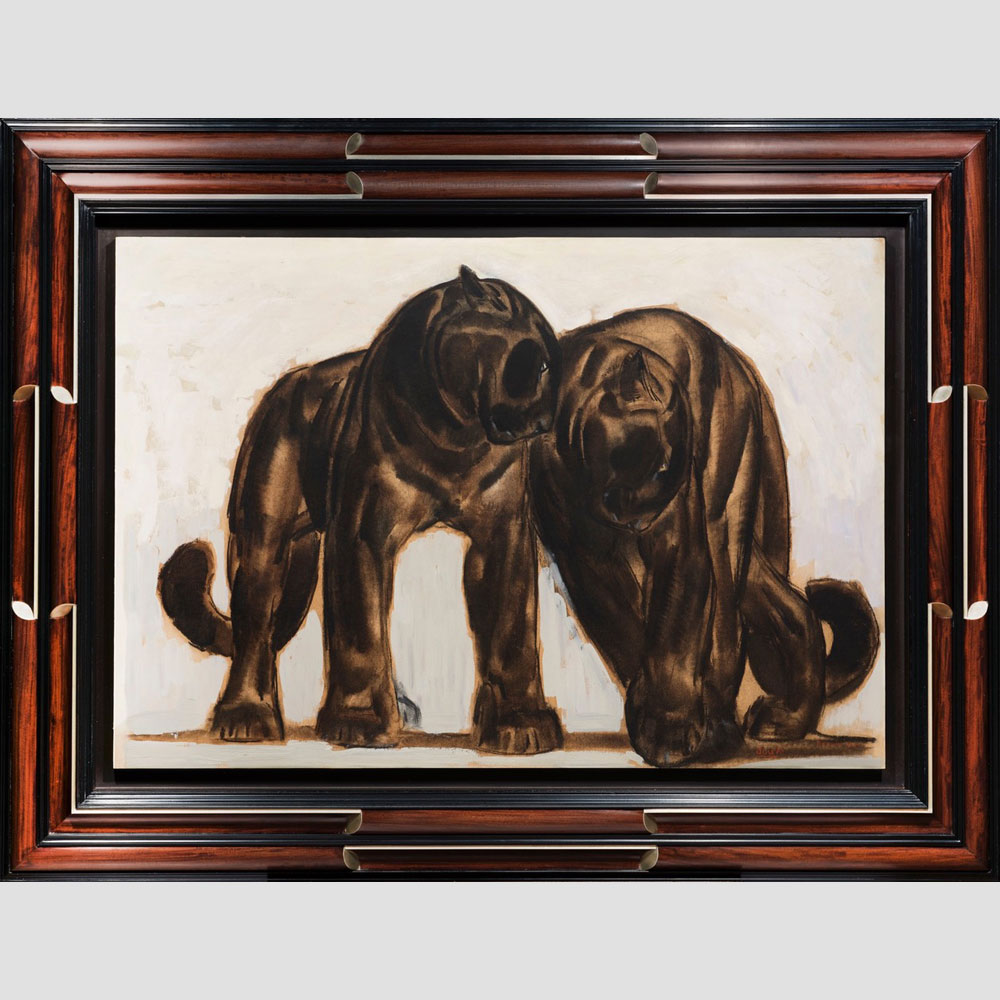
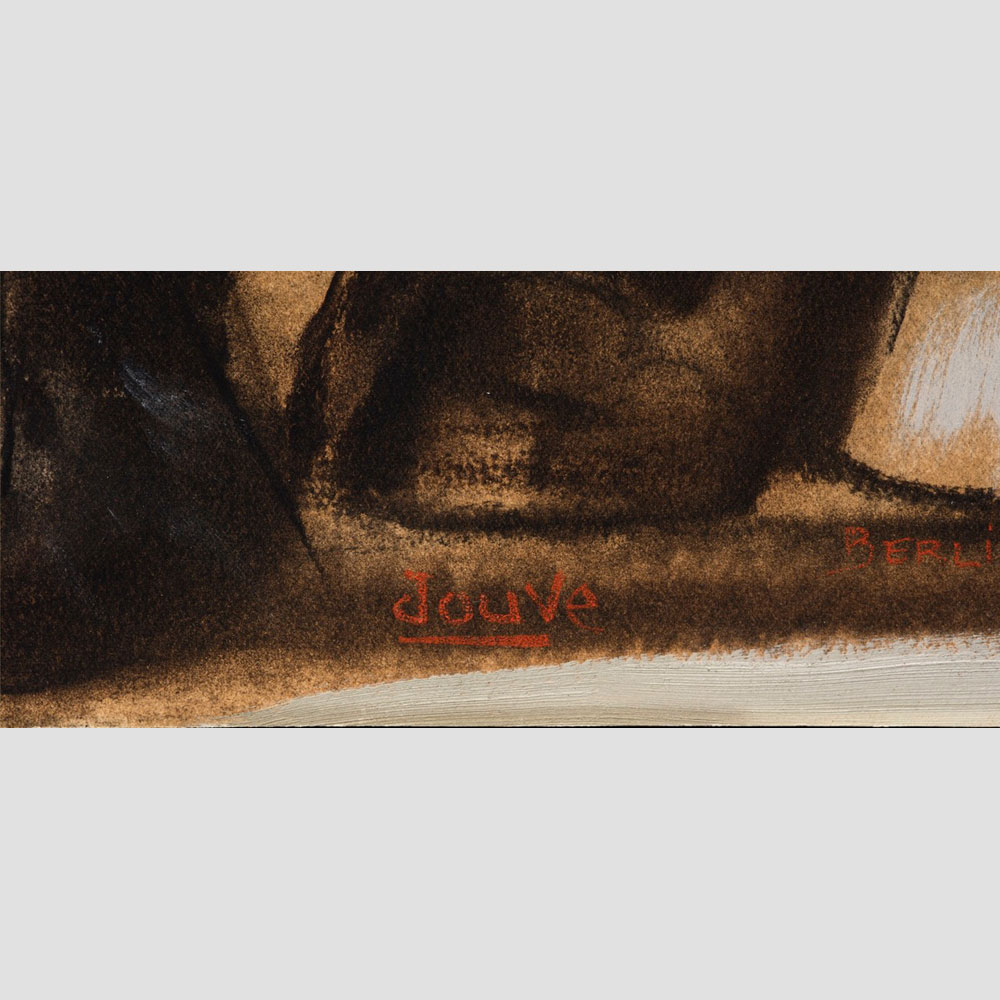
Signed in red, lower right
DIMENSIONS :
– 72 x 106 cm (105 x 138 cm encadré)
– 28 3/8 x 41 3/4 in. (41 3/8 x 54 3/8 in. framed)
Certificate of authenticity by Mrs. Amelie Marcilhac
BIBLIOGRAPHY : Félix Marcilhac, “Jouve, sculpteur animalier”, Les Éditions de l’Amateur, Paris, 2001, p. 193, for an in situ view at the Galerie Georges Petit in 1930, where a similar composition can be seen.
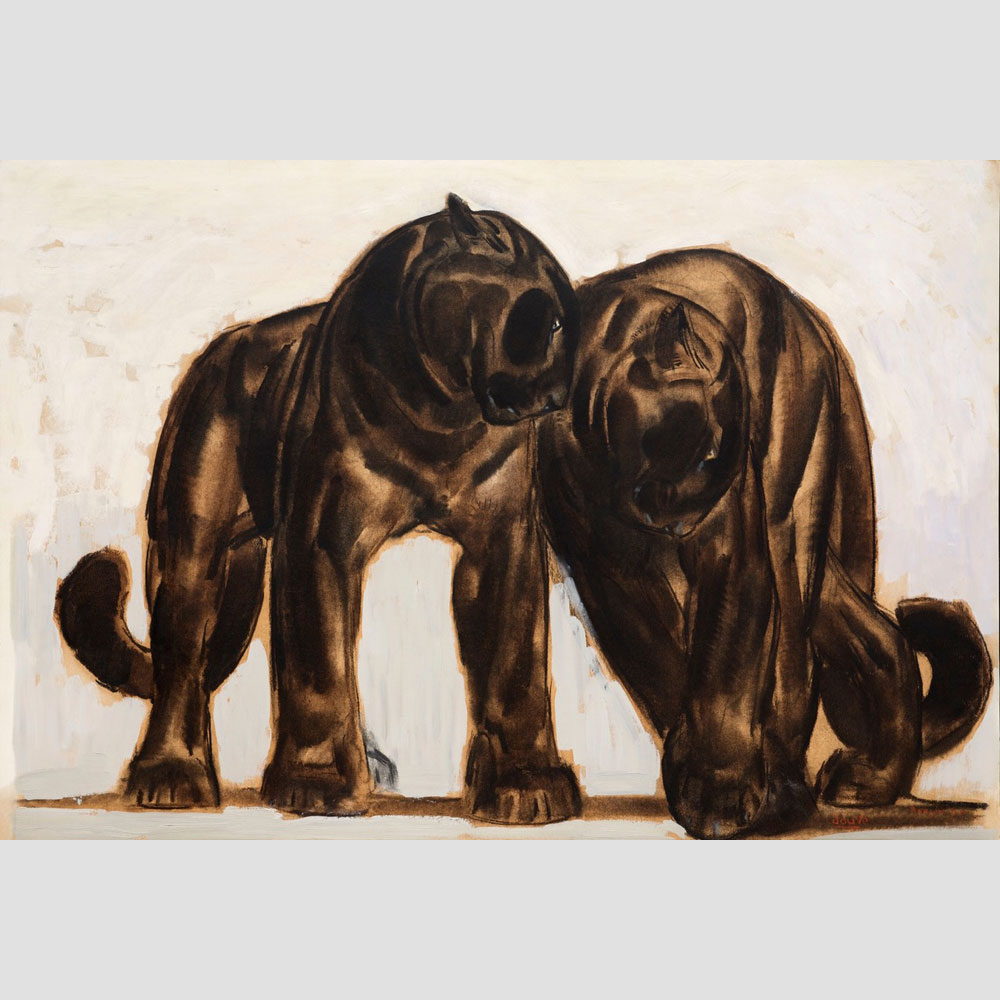
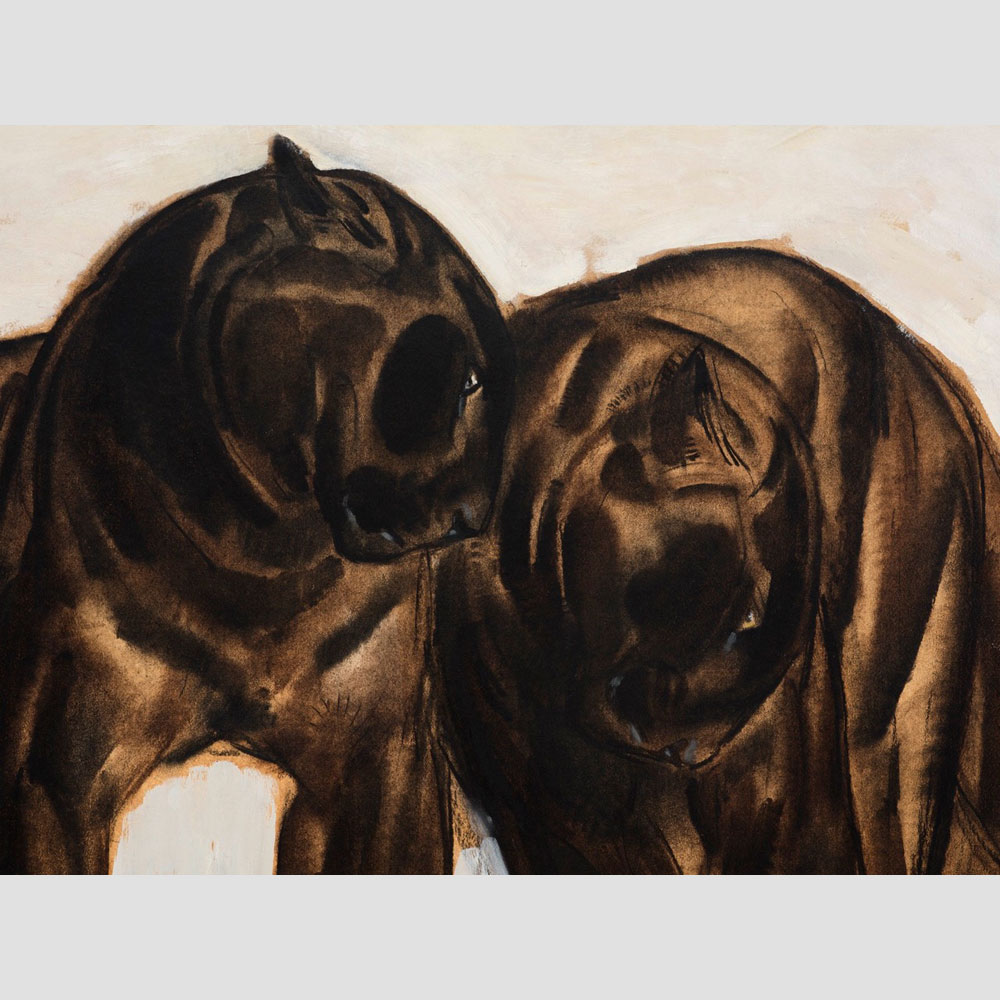
This work, created in 1930 by Paul Jouve, depicts two panthers captured in an attitude that is both powerful and intimate, observed from life at the Berlin Zoo. Faithful to his naturalistic approach, the artist renders the animals’ anatomical structure with great precision, while simplifying forms to enhance their monumentality. The use of brown and black tonal planes, almost sculptural in quality, gives the bodies a remarkable density, while the fluid contours and subtle modeling convey the muscular tension and suppleness characteristic of the animal. The deliberately pared-down background emphasizes the presence of the panthers, whose closeness suggests a silent relationship imbued with both tenderness and restrained strength. This composition perfectly illustrates Jouve’s mastery of animal representation, where scientific observation and decorative sensibility are balanced with elegance.